
Introduction
Reading stock charts and graphs is a fundamental skill for any investor or trader. These visual tools provide a wealth of information about a stock’s historical performance, helping you make informed decisions. This article will guide you through the basics of reading stock charts and graphs, covering essential elements and key indicators.
Understanding the Basics
What is a Stock Chart?
A stock chart is a graphical representation of a stock’s price movements over a specific period. It displays historical prices, volume, and other key data points, helping investors analyze trends and make predictions about future price movements.
Types of Stock Charts
- Line Chart: The simplest form, showing the closing prices over a period.
- Bar Chart: Displays the open, high, low, and close prices for each period.
- Candlestick Chart: Similar to bar charts but more visual, with color-coded bodies to show price movements.
Key Elements of a Stock Chart
- Time Frame: The time frame of a chart can vary from minutes to decades. Common time frames include:
-
- Intraday: Shows price movements within a single trading day.
- Daily: Displays daily closing prices over weeks, months, or years.
- Weekly/Monthly: Provides a longer-term view of the stock’s performance.
- Price Axis: The vertical axis (y-axis) represents the stock’s price. This axis shows the range of prices over the selected time frame.
- Time Axis: The horizontal axis (x-axis) represents the time period being analyzed. This axis shows the progression of time from left to right.
- Volume: Volume bars typically appear at the bottom of the chart, showing the number of shares traded during a specific period. Higher volume often indicates stronger interest or movement in the stock.
Reading Candlestick Charts
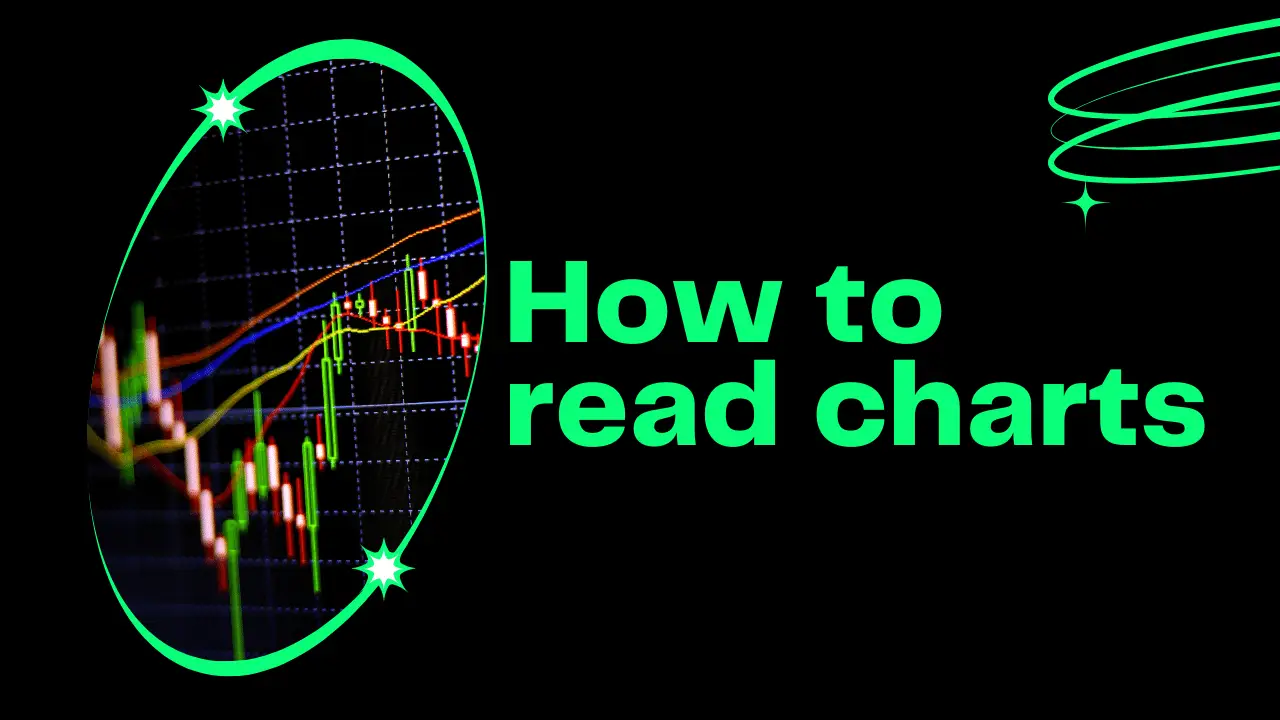
Candlestick charts are popular due to their visual appeal and detailed information. Each “candlestick” represents a specific period’s price movement.
Components of a Candlestick
- Body: The thick part of the candlestick shows the opening and closing prices.
-
- Green/White Body: Indicates the stock closed higher than it opened (bullish).
- Red/Black Body: Indicates the stock closed lower than it opened (bearish).
2. Wicks (Shadows): The thin lines above and below the body show the highest and lowest prices during the period.
-
- Upper Wick: The highest price.
- Lower Wick: The lowest price.
Example
- Bullish Candlestick: A green body with a lower open and a higher close.
- Bearish Candlestick: A red body with a higher open and a lower close.
Key Indicators and Patterns
- Moving Averages
- Simple Moving Average (SMA): The average stock price over a specific period (e.g., 50-day SMA).
- Exponential Moving Average (EMA): Similar to SMA but gives more weight to recent prices.
- Relative Strength Index (RSI)
- RSI: A momentum indicator that measures the speed and change of price movements, typically on a scale from 0 to 100.
- Overbought: RSI above 70 suggests the stock may be overbought.
- Oversold: RSI below 30 suggests the stock may be oversold.
- Bollinger Bands
- Bollinger Bands: Consist of a middle SMA band with upper and lower bands. These bands widen during periods of high volatility and contract during periods of low volatility.
- Upper Band: Often acts as a resistance level.
- Lower Band: Often acts as a support level.
- Support and Resistance
- Support Level: A price level where a stock tends to find buying interest and does not fall below easily.
- Resistance Level: A price level where a stock tends to find selling interest and does not rise above easily.
Analyzing Trends
- Uptrend
- Definition: A series of higher highs and higher lows.
- Indicator: Indicates a bullish market sentiment.
- Downtrend
- Definition: A series of lower highs and lower lows.
- Indicator: Indicates a bearish market sentiment.
- Sideways Trend (Consolidation)
- Definition: When a stock trades within a range, showing neither an uptrend nor a downtrend.
- Indicator: Indicates market indecision.
Example Analysis
Let’s analyze a hypothetical stock chart using these elements:
- Candlestick Chart: Over a 6-month period, we notice several green candlesticks indicating bullish days and red candlesticks indicating bearish days.
- Moving Averages: The 50-day SMA is above the 200-day SMA, suggesting a long-term uptrend.
- Volume: Spikes in volume during price increases suggest strong buying interest.
- RSI: Currently at 75, indicating the stock may be overbought.
- Support and Resistance: The stock has consistently bounced back from $50 (support) but struggles to break above $70 (resistance).
Conclusion
Reading stock charts and graphs is a vital skill for anyone involved in the stock market. By understanding the basic elements, key indicators, and how to analyze trends, you can make more informed trading and investment decisions. Remember, practice and continuous learning are key to mastering the art of chart reading.